CodeDance: A Dynamic Tool-integrated MLLM for Executable Visual Reasoning


1Beihang University   2Westlake University   3ByteDance Singapore   4ByteDance China
Equal Contribution      Corresponding Authors

Abstract

❝ We introduce CodeDance, a dynamic tool-integrated multimodal large language model that treats executable code as a general solver for visual reasoning. Instead of relying on rigid, text-only pipelines, CodeDance plans, composes, and executes visual–symbolic operations while rendering intermediate artifacts, enabling a transparent, self-checkable reasoning process.

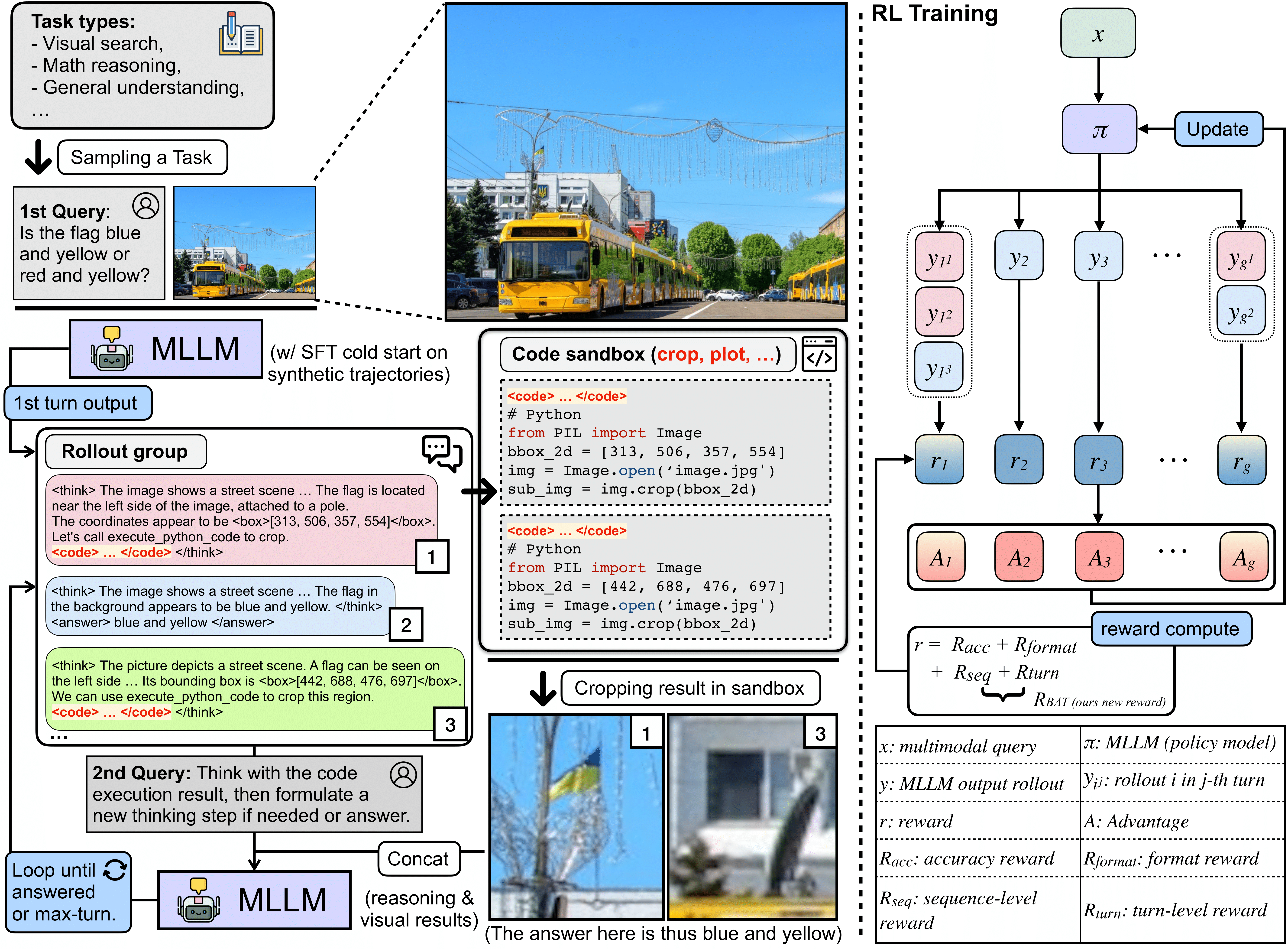
CodeDance scales up multimodal tool-based reasoning by letting the model think, write code, execute it, and reflect in a single loop. Rather than following fixed schemas, CodeDance dynamically decides when and how to invoke tools, orchestrates visual-symbolic operations (crop, draw, count, plot) in a sandbox, and uses intermediate visual evidence to guide subsequent reasoning over multiple interaction turns.

Our design choice yields transparent, self-checkable solutions to challenging visual search and reasoning tasks and offers a practical recipe for “thinking with images” via executable code and reinforcement learning.

❐ Overview and Training Receipes

CodeDance is a dynamic tool-integrated MLLM that leverages executable code as a general solver for visual reasoning, enabling a transparent, self-checkable reasoning process.

methodology

Our training / inference pipeline consists of three stages:

  • Stage 1: Cold-start via Supervised Fine-tuning. We construct a 34k high-quality dataset of executable multi-turn trajectories to initialize the model before RL.
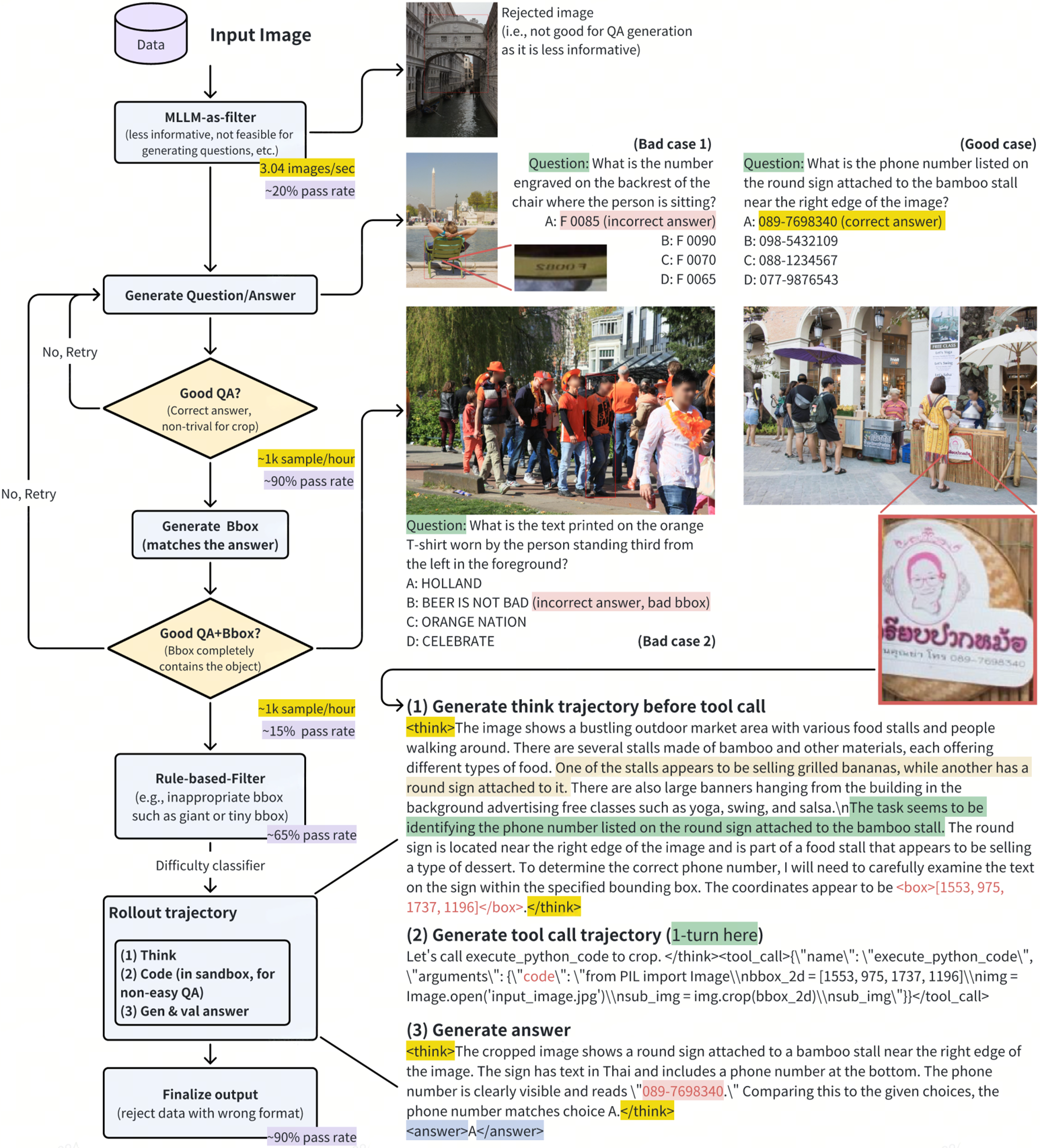
    • Weak-to-strong filtering. Aggregate public datasets (e.g., SA1B, GEOqa_plus, MMK12) and apply automatic filtering. We employ a weak model (Qwen2.5-VL-7B) to prune trivial cases, while a strong model further stratifies the remaining samples into medium and hard difficulty levels.
    • Multi-turn atomic supervision. We decompose hard cases into verifiable executable trajectories across three atomic categories:
      • Predefined visual operations. Annotated via predefined workflows to ensure reproducibility and scalability. Visual outputs (e.g., cropped views) serve as evidence for stepwise reasoning.
      • Mathematical computation. Measurement, algebra, aggregation executed via Python/NumPy/SymPy with error filtering. A Reasoning Model first produces chain-of-thought, which is segmented into a multi-step procedure; complex computational steps within the procedure are then translated into executable code.
      • Open-ended operations. The model can execute arbitrarily complex code that helps solve the task (e.g., drawing, annotation), enabling flexible and task-adaptive tool use.
  • Stage 2: Reinforcement Learning.

    We optimize with a composite reward that integrates outcome and tool signals. Our two-level reward (Balanced Adaptive Tool-call), denoted as \( R_{\mathrm{BAT}} \), balances task difficulty with step-wise tool-call correctness:

    \[ R_{\mathrm{BAT}} = R_{\mathrm{seq}} + R_{\mathrm{turn}}. \]
    • Sequence-level. Difficulty-aware incentives adapt to group accuracy to discourage redundant calls on easy problems and promote exploration on hard ones. Formally:

      Here, \(N_{\mathrm{succ}}(\tau)\) and \(N_{\mathrm{total}}(\tau)\) denote successful and total tool calls in trajectory \(\tau\). The difficulty factor \(d\) shrinks when the group accuracy \(\mu_{\mathrm{acc}}\) is high (easy queries) and grows when \(\mu_{\mathrm{acc}}\) is low (hard queries), suppressing redundant tool invocations on easy cases while amplifying rewards for helpful tool use on challenging ones.

      \[ R_{\mathrm{seq}} = \Big(0.5 + 0.5 \cdot \mathbb{I}_{R_{\mathrm{acc}}(\tau) > 0}\Big) \cdot d \cdot \frac{N_{\mathrm{succ}}(\tau)}{N_{\mathrm{total}}(\tau)}, \quad \] where \[ d = \sigma\!\big(\gamma (0.5 - \mu_{\mathrm{acc}})\big) - \delta, \quad \sigma(z) = \frac{1}{1 + e^{-z}}. \]
    • Turn-level. Immediate penalties for failed executions plus a batch-normalized advantage to provide dense correction. For each turn \(m\), failed code execution incurs an immediate penalty \(r_{\mathrm{turn},m} = -0.5\) (otherwise \(0\)). To capture long-term effects, we define the accumulated discounted return and advantage as:

      \[ G_{\mathrm{turn}}^{m} = r_{\mathrm{turn}}^{m} + \beta \cdot G_{\mathrm{turn}}^{m+1}, \qquad A_{\mathrm{turn}}^{m} = \frac{G_{\mathrm{turn}}^{m} - \mu_{\mathrm{batch}}}{\sigma_{\mathrm{batch}}}. \]

      This turn-level signal assigns credit to correct intermediate tool executions, discouraging reward hacking where the final answer is correct but tool use is erroneous.

      The final advantage combines sequence- and turn-level signals:

      \[ A(\tau) = A_{\mathrm{seq}}\!\big(R_{\mathrm{acc}}, R_{\mathrm{format}}, R_{\mathrm{seq}}\big) + A_{\mathrm{turn}}\!\big(G_{\mathrm{turn}}\big). \]
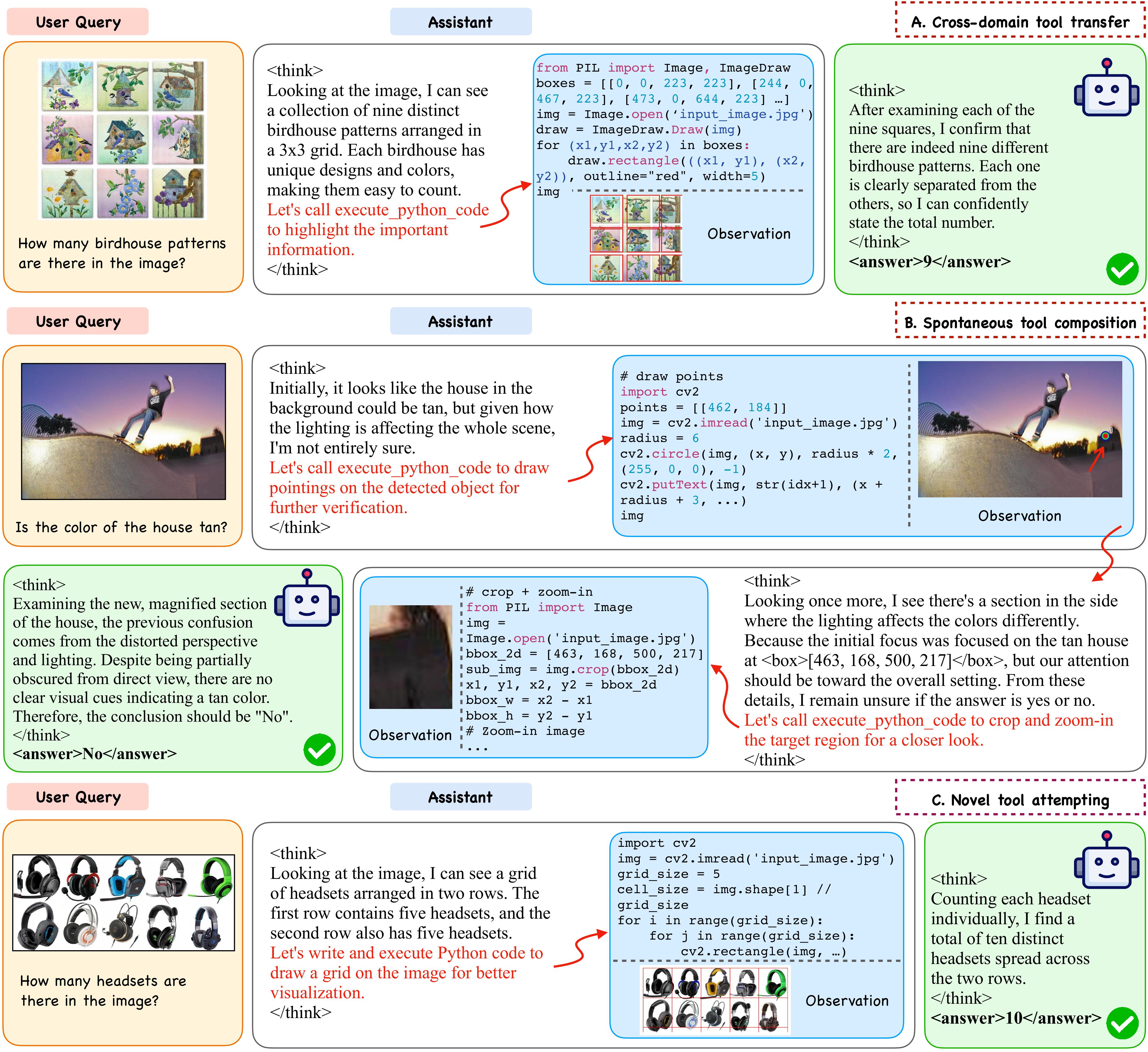
  • Stage 3: Test-Time Extend and Scaling. Without task-specific fine-tuning, CodeDance exhibits emergent capabilities beyond supervised primitives: novel tool invocations, unseen tool compositions, and cross-task transfer, demonstrating strong generalization at inference. We additionally validate the potential of scalability after observing the empirial novel reasoning trajecories incentivized during RL.

♫ Dynamic visual tool-calling

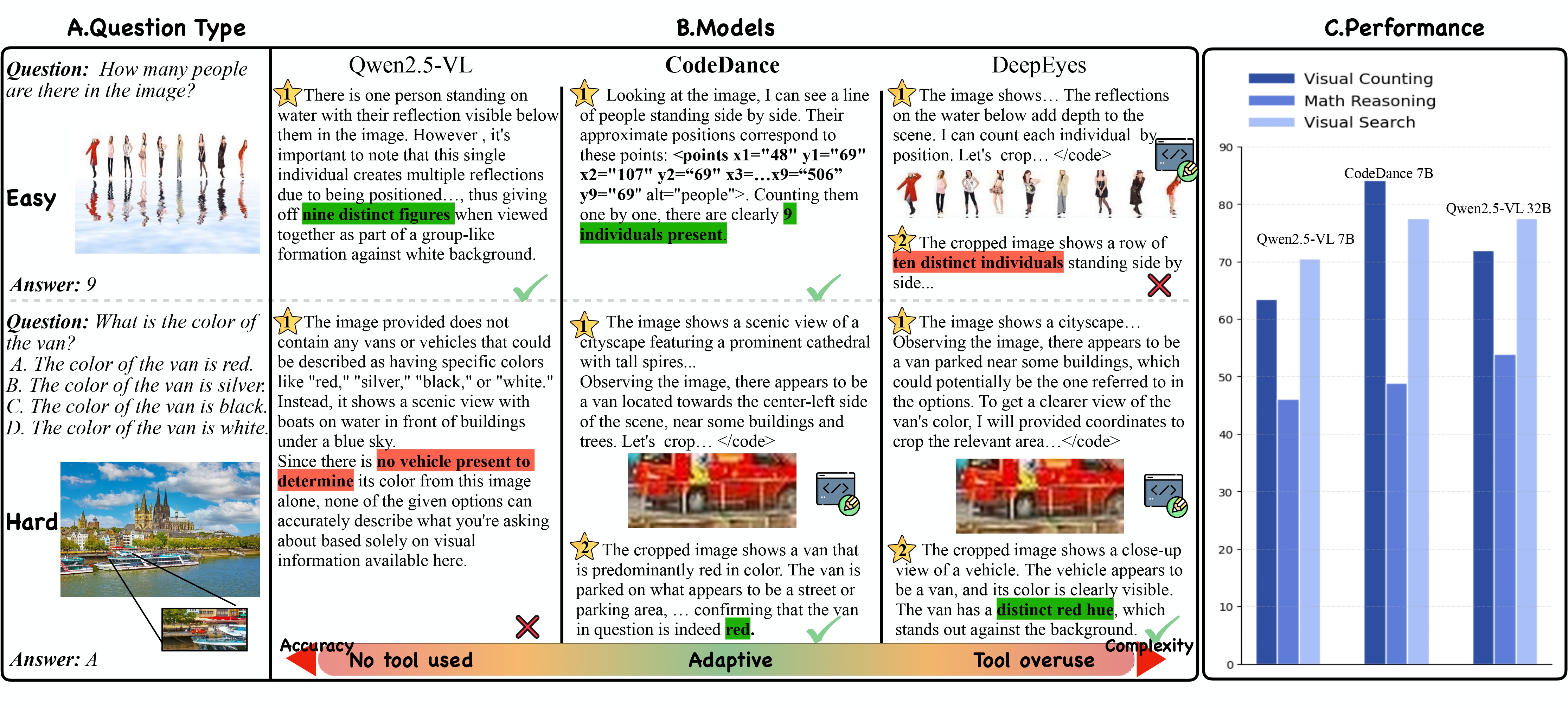
CodeDance dynamically invokes tools according to task difficulty to prevent both tool underuse (unable to invoke tools on challenging tasks) and tool overuse (redundant calls on easy tasks).
CodeDance teaser

Motivation and effectiveness of dynamic tool invocation in CodeDance. Left: qualitative examples show that both tool underuse (unable to invoke tools on challenging tasks) and tool overuse (redundant calls on easy tasks) lead to hallucinated reasoning, incorrect answers, and unnecessary complexity (more reasoning turns and longer rollout time), whereas CodeDance dynamically invokes tools according to task difficulty to obtain correct solutions. Right: quantitative results show CodeDance-7B consistently surpasses all Qwen2.5-VL 7B baselines and exceeds the 32B version on several tasks.

Synthesis of tool-integrated visual trajecories

To initialize CodeDance before RL, we curate a high-quality cold-start dataset of executable multimodal trajectories. Following the pipeline described in our methodology and appendix, we apply weak-to-strong filtering to stratify difficulty and then build multi-turn atomic supervision.
Left: An example of our reasoning trajectory synthesis.
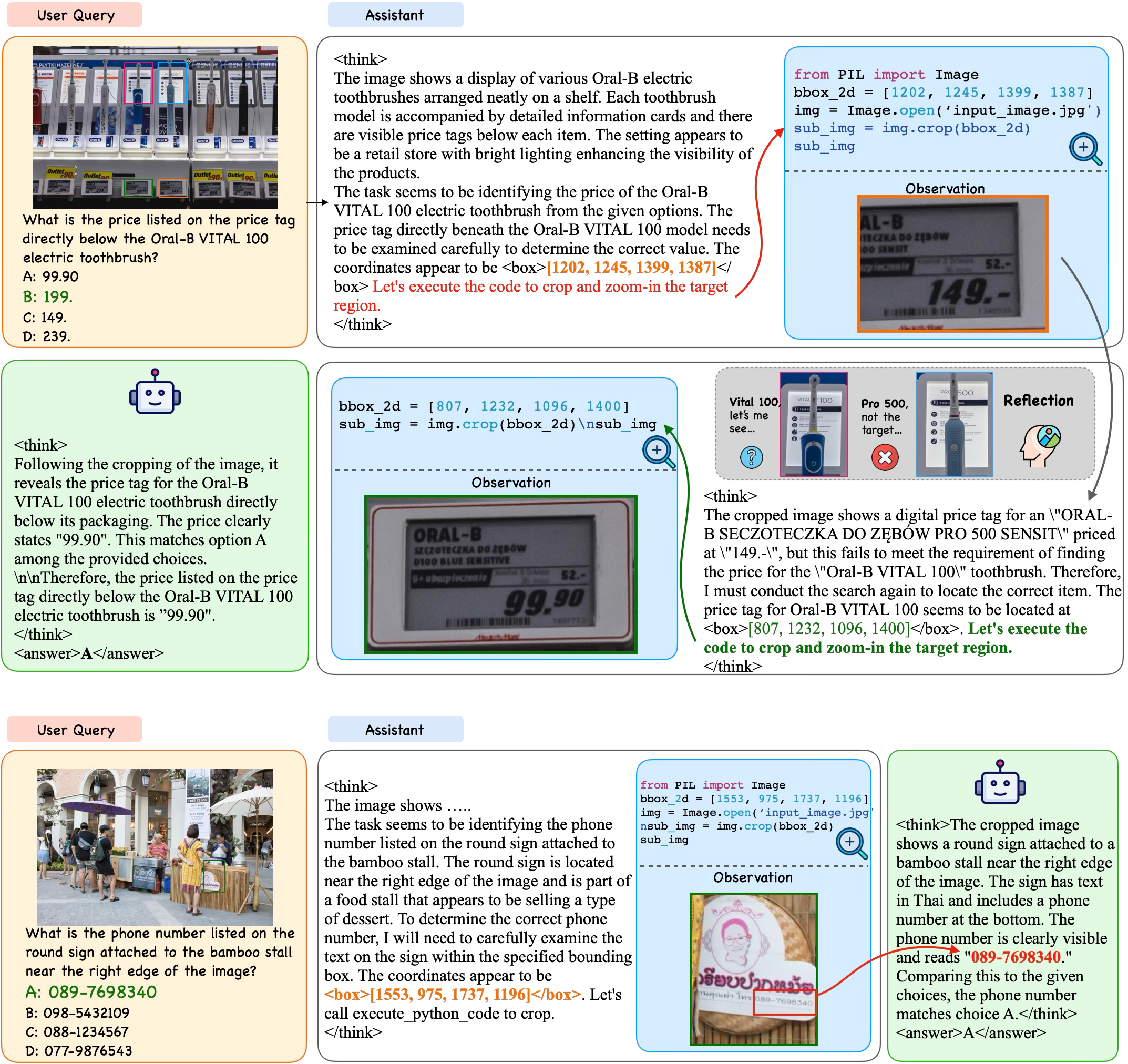
Right: (scroll to the right) An example of resulting curated reasoning trajectory.

dataset_pipeline dataset_showcase

Main Experiments

We conduct systematic evaluations across visual search, math, counting, and chart understanding benchmarks. CodeDance consistently outperforms text-only and schema-driven baselines and, in several settings, surpasses larger open-source and advanced closed-source models.

Experiment results on benchmarks including Counting, Visual Search, and General datasets.
Model                            Visual Counting Visual Search General
CountBenchQA PixmoCount V*Bench HR4K HR8K ChartQA CharXiv
Closed-Source MLLMs
GPT-4o 87.9 - 67.5 65.0 59.6 86.7 47.1
Open-Source MLLMs
Llava-OneVision-7B 82.3 54.4 72.7 68.5 60.0 80.4 27.1
Llava-OneVision-72B - 60.7 73.8 66.3 60.9 83.7 -
InternVL2.5-8B 55.9 - 73.7 72.0 65.5 82.8 37.2
InternVL3-8B 80.3 - 70.2 70.5 70.0 86.1 38.3
InternVL3-78B - - 76.4 75.5 67.3 89.7 46.0
Qwen2.5-VL-72B 93.6 62.3 84.8 79.4 76.3 89.5 49.7
Qwen2.5-VL-32B 87.8 56.0 85.9 74.8 71.6 - 47.6
Qwen2.5-VL-7B 76.5 50.4 76.4 69.0 66.0 86.3 42.1
Open-Source MLLMs with Tools
Pixel Reasoner-7B - - 84.3 72.9 66.9 - -
Deepeyes-7B 80.4 57.2 90.4 74.8 71.9 78.2 -
Thyme-VL-7B 84.8 - 82.2 77.0 72.0 86.1 44.2
CodeDance-7B 91.2 77.1 84.8 75.2 72.3 87.5 44.1
Δ v.s. Qwen2.5-VL-7B ↑19.2% ↑53.0% ↑11.0% ↑9.0% ↑9.5% ↑1.4% ↑4.7%


Experiment results on math benchmarks.
Model MathVision MathVista MathVerse WeMath
GPT-4o 36.5 63.4 35.3 44.2
Qwen2.5-VL-72B 38.1 74.8 57.6 -
R1-OneVision-7B 29.9 64.1 40.0 -
R1-VL-7B 24.7 63.5 40.0 -
InternVL2.5-8B 22.0 64.4 39.5 23.9
LLaVA-OV-7B 18.4 63.2 26.2 17.3
Qwen2.5-VL-7B 25.0 68.1 45.1 35.4
DeepEyes-7B 26.6 70.1 47.3 38.9
CodeDance-7B (Ours) 29.6 70.3 46.8 39.6

Experiment results on reward design.
Components CountBench
Acc. / Turns
PixmoCount
Acc. / Turns
MathVision
Acc. / Turns
MathVerse
Acc. / Turns
V*
Acc. / Turns
HR4K
Acc. / Turns
HR8K
Acc. / Turns
Avg.
Acc. / Turns
SFT Cold-Start (w/o RL) 85.3
1.2749
66.9
1.3902
23.0
2.8388
41.4
2.1904
82.7
2.0052
72.1
1.1713
67.1
1.0875
62.6
1.7083
RL with Racc + Rformat 88.4
1.0200
71.2
1.0170
26.0
2.1086
46.5
1.9569
82.7
1.1728
73.4
1.0413
69.0
1.0375
65.3
1.3363
+ RDeepEyes 85.1
2.5960
64.4
2.5341
25.2
3.2270
44.0
2.5190
83.3
2.0000
74.6
2.0888
68.4
2.0525
63.6
2.4311
+ RBAT (Ours) 89.0
1.0000
72.5
1.0000
27.0
2.0461
46.3
2.1662
82.7
1.2094
73.8
1.2251
69.4
1.1950
65.8
1.4060

Note: † denotes results reported from official papers.

Key Findings: Emergent Behaviors during RL

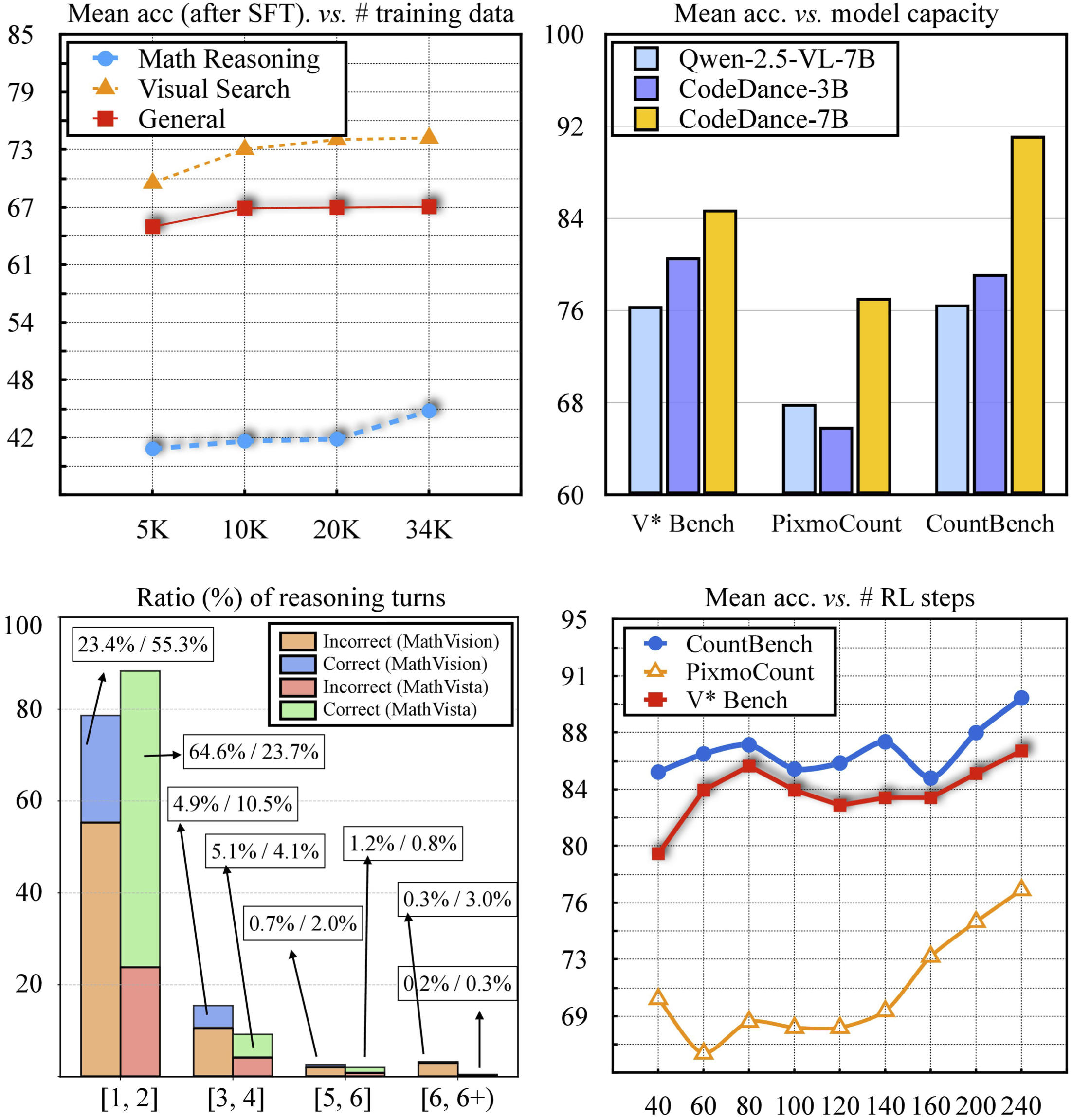
Throughout the RL process, we consistently observe novel and surprising reasoning trajectories (below) that go beyond the atomic supervision provided during SFT. These findings point toward the scalability of code as a general reasoning medium, and we empirically study the potential in our main paper.

cold_start_dataset

BibTex

If you find our work useful and inspiring to your research, please consider citing our work:
@article{Song2025codedance,
              title={CodeDance: A Dynamic Tool-integrated MLLM for Executable Visual Reasoning},
              author={Song, Qi and Li, Honglin and Yu, Yingchen and Zhou, Haoyi and Yang, Lin and Bai, Song and She, Qi and Huang, Zilong and Zhao, Yunqing},
              journal={arXiv preprint arXiv:2512.17312},
              year={2025}
            }